How can Jev help with ad-library research?
Jev can help classify and prioritise observations supplied to it by a research workflow. It is not an ad library or a source of competitors' private conversion data. A visible, long-running or frequently repeated ad can suggest a creative pattern worth investigating; it does not establish the best-performing campaign.
What does Jev actually do?
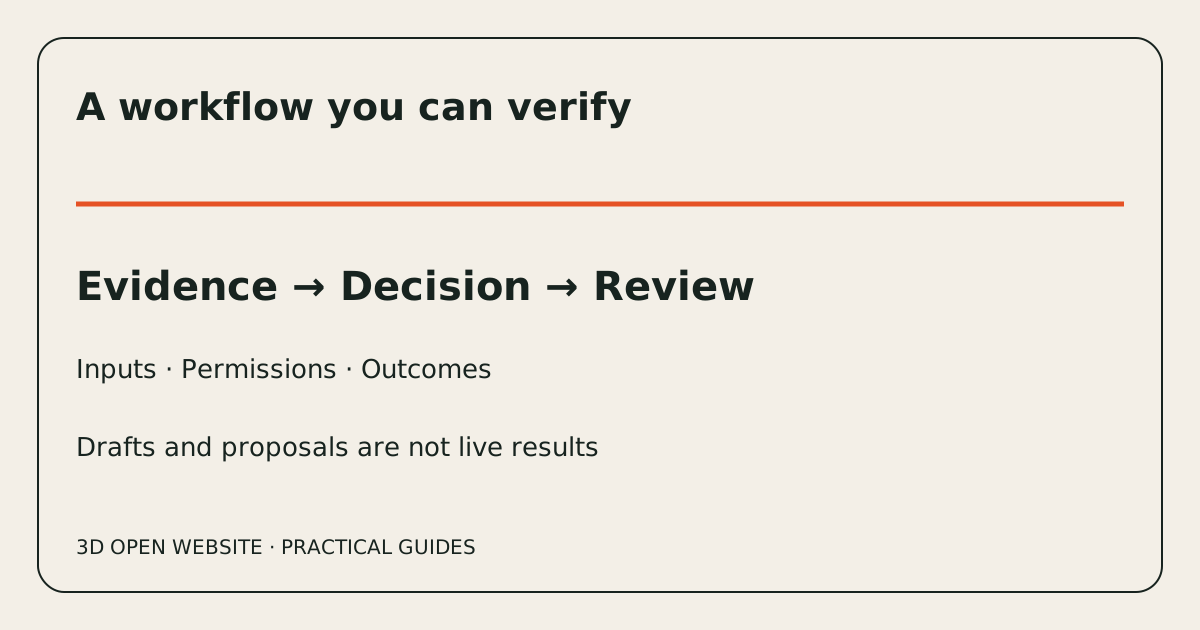
TypeSafe documents Jev as a model for typed decisions over supplied state. Its structured outputs can support routing and evaluation. In the workflow below, a browser or authorised data source collects public observations, a generative model drafts a summary, and Jev evaluates narrow questions. This is a reproducible proposed workflow, not a published client-performance case or a claim that we measured competitor profitability.
Capture evidence before asking for a score
For every ad, save the library URL, advertiser, capture date, visible market or filters, message, format and destination. Distinguish an observed start date from an inferred duration. Mark metrics unavailable when the library does not provide them. Respect platform access rules and image rights; research does not grant permission to copy a competitor's creative.
Use a constrained review rubric
- Ask whether the supplied record contains a source and date.
- Classify its customer intent against a defined list, with an unknown option.
- Score message-to-page consistency using written levels and the supplied page evidence.
- Route unsupported claims, conflicting records and uncertain decisions to review.
- Log the model/version, rubric and decision alongside the evidence, then check a labelled sample for mistakes.
Can a model score prove which ad wins?
No. A probability or rubric score is a model judgement about the question asked, not observed click-through rate, acquisition cost or return on ad spend. To identify a winner in your own account, use authorised campaign data, attribution rules, comparable periods and qualified business outcomes. Keep that evaluation separate from public-library creative research.
How does this become an original campaign?
Translate the research into hypotheses about audience questions, proof and page structure. Develop your own message and licensed assets, then test with a bounded budget and approval. The ad-library guide explains collection; the architecture guide explains execution gates. Keep API credentials on the server, never in downloadable examples or browser bundles.
Ready to Start Your Project?
Discuss your audience, services and enquiry process with our studio.
Get in TouchRelated Posts
How do I turn a trend into a useful campaign brief?
Connect a verified trend to customer intent, an offer, a landing page, a limited experiment and a clear decision rule.
How do I use GPT to write ads that are accurate?
Give GPT a factual brief, generate distinct message angles and review every claim before adapting copy for Google, Meta or ChatGPT ads.
How do I build an agentic marketing workflow?
Connect research, typed decisions, draft generation, review, publishing and measurement with permissions, logs and safe retry behaviour.