How do I build an agentic marketing workflow?
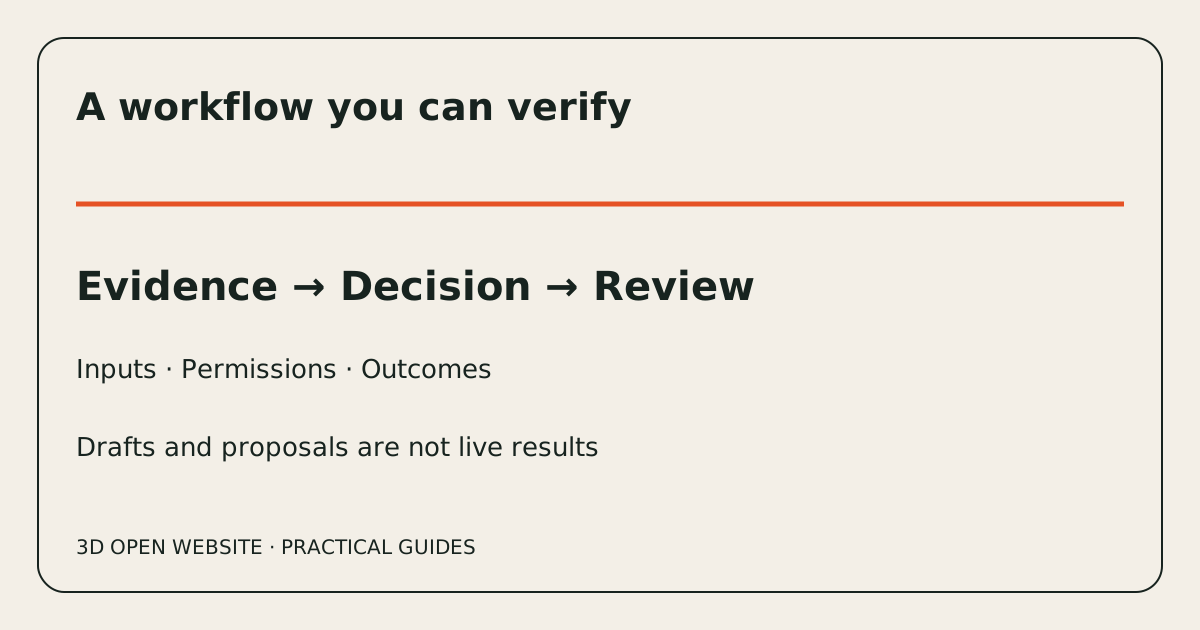
An agentic marketing workflow connects evidence, decisions and tools around a business objective. It is more than scheduling prompts: the system needs defined inputs, authorised actions, review states and reliable handling when a provider fails.
Design the workflow as explicit states
Use a sequence such as research collected, evidence checked, brief approved, draft produced, claims reviewed, assets approved, release scheduled and outcome reviewed. Store the state and responsible owner. A model's confident sentence must not silently move a draft into a live paid campaign.
Assign models by evaluated task
A generative model may draft copy or implementation options; a typed decision model such as Jev may classify records; deterministic code should enforce permissions and validate data. Compare candidates on representative tasks rather than declaring one model best for all marketing. Keep source material and review notes available for tracing mistakes.
What should the technical contract contain?
- Validate incoming data, source URLs and expected fields.
- Keep credentials server-side with the minimum access needed.
- Give each action a durable identifier so retries cannot duplicate a publication or customer message.
- Handle timeouts, rate limits and provider outages with bounded retries and an explicit review queue.
- Require approval for spending, new access and externally published claims.
- Keep an audit trail of inputs, model/version, decisions, approvals and actual tool results.
Test failure before scaling
Use synthetic records and non-production destinations to test missing evidence, duplicate events, invalid credentials and rejected publishing. A successful model response is not proof that a post was published or an enquiry stored. Verify the destination and keep customer-facing confirmations tied to real completion.
How does it fit a custom website?
The website supplies structured service information, landing pages and reliable first-party actions. The workflow can prepare briefs, route approved assets or surface enquiry categories without collecting unnecessary personal data. Start with one narrow loop, such as approved research to a draft campaign brief. Expand only when its quality, security and operating cost are understood. See the Jev evidence example and webhook reliability checklist.
Ready to Start Your Project?
Discuss your audience, services and enquiry process with our studio.
Get in TouchRelated Posts
How do I use GPT to write ads that are accurate?
Give GPT a factual brief, generate distinct message angles and review every claim before adapting copy for Google, Meta or ChatGPT ads.
How can Jev help with ad-library research?
Use Jev for structured evidence triage, not invented performance rankings. Keep ad observations, hypotheses and account results separate.
How do you connect a marketing campaign, landing page and useful measurement?
Match the ad promise to a focused page and a defined customer outcome. Separate a saved enquiry from a qualified opportunity, and test changes with consent, budget limits and a clear decision rule.